Showing posts with label Science-Fiction. Show all posts

Wednesday, January 8, 2014

Space Opera by Wally Wood

I love pure pen and ink drawings that make great use of silhouettes and light.  This little masterpiece by Wally Wood takes me back to the early days of science fiction and EC Comics.


Nuff Said!

Tuesday, January 3, 2012

Spin by Robert Charles Wilson

I just finished reading Spin by Robert Charles Wilson
as part of our Beyond Reality book club reading group on GoodReads. I definitely thought the premise behind Spin was a great SF concept: the Earth gets wrapped in a membrane which cuts it off from the Sun, satellites, and the stars.  As time proceeds normally on Earth, outside the membrane time is accelerating at mind boggling speeds.  Aliens, or whoever caused the bubble, seem to have propelled the Earth on the fast track to the end of the solar system.

As a kid I always shuddered to think of the Sun expanding and consuming the Earth.  And then I would feel some relief when the teacher said, this won't happen for billions of years!  This book taps into that fear and it propelled me through to the end.  Several of the concepts that Wilson has created around this are fascinating, involving time displacement, a Martian colony, nanotechnology, etc. 

The main narrator is a doctor, Tyler Dupree (swear that name sounds like it came from another novel), who is not a genius but is the best friend of the mercurial genius who helps solve the mystery of the Spin membrane, Jason Lawton.  Jason has a twin sister, Diane, who Tyler loves but can't have because he's poor and they are rich.  This part of the novel is a good classic structure: an outsider who observes great epic things happening and can tell us all about them in the novel.  The Spin event occurs when they are kids and their whole lives are defined by it.  Jason becomes the head of an agency that works with Nasa to analyze the Spin membrane and what is happening outside the Earth.  Diane becomes involved in a religious cult that sees the apocalypse coming down the horizon.  Tyler becomes a doctor and takes a job as Jason's personal physician.  The main problem I had with this book, which prevented me from giving it 4 or 5 stars, were these 3 characters.  They didn't seem that vibrant to me.  Tyler spends decades pining away for Diane, resisting all but one other relationship.  Diane seems like an idiot, involved in a stupid cult that almost kills her.  Jason is the least well developed, he's just there to be the genius who figures it all out, with no relationships of his own other than the one with his father.

I am still glad I read the book.  With cool SF concepts and a sprawling plot that spans decades, I can see why this novel won the Hugo award.  Three out of five stars.  For more discussion on Spin, check out The Incomparable podcast episode 11 (To Be Continued).  They made an interesting comment about how many of the SF concepts in Spin had been previously used in other works.  Nuff Said.

Thursday, March 10, 2011

Ace Paperback Covers: Conan of Cimmeria by Frazetta and This Immortal by Gray Morrow

A few years ago, I started reading electronic books on various devices.  Today, I hardly read any physical book, except for comic books and highly technical subjects.  I’m avidly following the e-book industry and fascinated by how quickly it is growing.  At the same time, I’m feeling pangs of nostalgia for old paperbacks from my youth!

Conan of Cimmeria Ace Paperback cover by Frank Frazetta

Case in point, this Ace paperback, Robert E. Howard’s Conan of Cimmeria.  I found this at Half Price Books the other day, in great condition, even poly-bagged, for a mere $2.  Frank Frazetta’s paintings on these books set the world on fire and helped sell millions of Conan books all over the world.  This collection of stories contains The Frost Giant’s Daughter, which is portrayed to great effect by Frazetta.  Who couldn’t help but picture Frazetta’s creations in their mind while reading Howard’s purple prose?

Frank Frazetta's full painting for Conan of Cimmeria

Frazetta’s full cover painting for this scene is even more glorious.  There were several different editions of the these Conan paperbacks.  The one I just bought definitely is published by “Ace” and the back cover is just Frazetta’s painting, sans any cover copy.  It was published in 1983 and also contains some interior illustrations by Esteban Moroto. 

Lancer published the original paperback series in the 1970s with a different cover treatment.  Gary Romeo has a terrific article titled Defending the Lancers on his website, with a review for each Conan paperback and a gallery of each cover.

Roger Zelazny This Immortal paperback cover by Gray Morrow

When I made the switch to reading e-books, I was also getting ready to move to a new house.  I had tons of physical books that I dreaded moving.  I sold stuff to a used bookstore and donated the rest to a local library.  But there were a few special books that I just couldn’t let go.  One of them was the 1965 Ace paperback edition of Roger Zelazny’s This Immortal.  I haven’t read this novel in decades, but I love the cover, even if it has little to do with the story inside.  The cover painting was by Gray Morrow, a very talented artist who also drew comics for Marvel and DC, including the very first Man-Thing solo story.  You couldn’t help but have this cover strike out at you on the newsstand from any direction.  That red landscape, with the moon hovering impossibly close by in the background, is pure SF pulpy goodness!  Zelazny has always been one of my top favorite SF writers, his Amber series is something I can re-read every few years, as well as Doorways in the Sand.

I looked to see if I could find a scan of this painting in original form, and came up empty.  Instead I discovered a very nice article on Gray Morrow on the Bronze Age of Blogs.  I had completely forgotten that Morrow had also worked on The Illustrated Roger Zelazny, a special album that he produced for Byron Preiss.  It was sad to read that Morrow committed suicide in 2001.  He was a very unique artist with an unmistakable style that I’ll never forget.  Nuff Said.

Wednesday, March 9, 2011

Isaac Asimov’s Science Fiction Magazine: The Early Years

Isaac Asimov's Science Fiction Magazine Fall 1977

I started reading science fiction in the 1970s.  The first SF related novel I can remember reading as a kid was the Tom Swift Jr Adventures series, utterly fantastic tales about about a kid genius building robots and atomic earth blasters.  Later I graduated to real SF novels like Dune.  Eventually I discovered Analog SF magazine on the newsstands, learned about famous SF authors like Harlan Ellison, Robert Silverberg, and Isaac Asimov.  In 1977, the good doctor got his own publication: Isaac Asimov’s Science Fiction Magazine.  On a recent trip to Bookbuyers in Mountain View, I snagged a couple of early issues for the heck of it.  The cover above is from the third issue in 1977.  The first few issues had Asimov prominently displayed on the cover, and if you had ever seen him, there was no mistaking that famous face! 

Isaac Asimov's Science Fiction Magazine Jan-Feb 1978

George Scithers was the editor for the first 5 years of Asimov’s SF magazine.  He lined up quite a staggering roster of talent for these early issues.  The one above, cover dated Jan-Feb 1978, was the fifth issue published in sequence, and featured stories by Stanley Schmidt, Keith Laumer, L. Sprague de Camp, Nancy Kress, Lisa Tuttle, and a rising star named John Varley.  Varley’s lead story was an excellent SF detective story, The Barbie Murders.  Scithers had decided to switch from full Asimov portraits to cover paintings with this issue, putting the Doctor’s image in the O of the logo, a cute touch.  Can you tell how much of an Asimov fanboy I am?  I read both volumes of his autobiography, each the size of Kentucky.

Back Cover of Asimov's SF Magazine 1977

The advertisements in any old publication are extremely interesting to me.  The back covers usually had an ad for the Science Fiction Book Club, tantalizing readers with Any 4 Science Fiction Best Sellers for Just 10 cents!  I joined and received the book shown here, The Hugo Winners, an 800+ page tome with short stories, each with a introduction by Asimov.  Sometimes the introductions were more entertaining than the stories themselves—Asimov would usually reveal some history of early SF history or fandom.  I also received Dangerous Visions, Foundation Trilogy, and a lot of other classic SF books.  I amassed a large SF library out of this book club, which I sold off over the years.  If you are feeling nostalgic over these book club editions, Bookbuyers in Mountain View has a special section devoted to them, in addition to a great selection of old Asimov’s, Analog, and Fantasy and Science Fiction magazines.


Some of the other ads are interesting.  Ads for records, such as Asimov’s Nightfall.  Berkeley Books, which had an impressive author line up.  Deus Irae, by Philip K Dick and Roger Zelazny, published by Dell Books.  I find the classified ad section in the back of these publications extremely fascinating.  Some of them are primitive prototypes of email scams, others are pyramid schemes, while a few are targeted at self-publishing.
I am sure that I bought the first few years of this magazine and threw them all away at some point.  What was I thinking?  These are classic SF collectibles.  Nuff Said!

Saturday, September 11, 2010

Steampunk at Burning Man photo by Trey Ratcliff

My nephew, Trey Ratcliff, has one of the most popular travel/HDR photography blogs in the world, Stuck In Customs.  Trey took a little trip to Burning Man last week and took this awesome photo at night.

from Trey Ratcliff at www.stuckincustoms.com

Doesn't this image remind you of a character in a steampunk novel?  The thought occurred to Trey as well, who just finished reading Cherie Priest's Boneshaker after I turned him on to it.  Love everything about that costume, but the cherry on top is that light on her chest.  Nuff Said!

Link: Stuck in Customs, #1 Travel Photography Blog

Link: Boneshaker by Cherie Priest

Wednesday, August 18, 2010

Star Trek: Martin Ansin Space Seed Poster

Yesterday, I featured Martin Ansin's rendition of the Flash.  Here is his take on classic Star Trek.


Metropolis - Final


Ansin created this poster in conjunction with the Alamo Drafthouse.  Nuff Said!


Link:  Martin Ansin, Illustrator

Saturday, August 14, 2010

Two Stunning Images from The Stars My Destination by Howard Chaykin

I found this great poster advertising an adaption of Alfred Bester's The Stars My Destination in an old issue of Jim Steranko's MediaScene magazine.
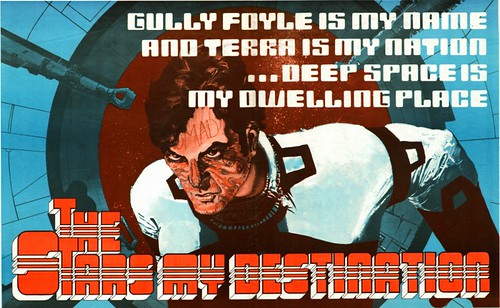
Stars My Destination poster by Howard Chaykin

The artwork is by Howard Chaykin and presents a tantalizing image of Gulliver Foyle, especially if you've already read the novel.  This was done around Chaykin's late 70s period, after he had drawn the Star Wars adaption and other star-spanning tales.

Stars My Destination Chaykin Nomad

Chaykin worked with Byron Preiss on adapting Bester's classic into a graphically illustrated form.  The result was interesting,  It wasn't really a comic/graphic novel as the text was left on the side with the illustrations showing a bunch of scenes.  I was certainly entranced by the art and images like the above, where Foyle views the tattoos on his face for the first time.  Chaykin used a lot of new painting/color techniques that I had never seen before, the effect was unique.  Nuff Said!

Thursday, August 12, 2010

Six Million Dollar Man by Neal Adams and Mike Hinge

The Six Million Dollar Man owned sci-fi TV in the 1970s, when Steve Austin was the biggest and most expensive hero on the tube.

Six Million Dollar Man cover by Neal Adams 1976

Neal Adams did this painting for a magazine sized Six Million Dollar Man comic published by Charlton.  It appeared on newsstands right next to Creepy, Vampirella, Dracula Lives, and Mad.  Adams gave a pretty awesome display of Austin's bionic strength, ripping that engine out of the hood like it was made of tin foil.  If only the TV show had been able to display that!

Six Million Dollar Man poster by Mike Hinge from MediaScene 10 1974

Mike Hinge did this double page splash poster (for Jim Steranko's MediaScene magazine #10 in 1974) that makes Steve Austin look more like Nick Fury 2.0.  The cool element here is that raw metal cyborg hand holding out the watch on the left. 

If only they had painted the Bionic Woman, too.  Nuff Said!

Tuesday, August 10, 2010

Movie Posters: Charton Heston in Omega Man, Soylent Green, and Earthquake!

Charlton Heston was the Big Kahuna of the silver screen back in the 60s and 70s.  Here are some posters from old Chuck's silver age of science fiction...

omega_man_xlg

The Omega Man (1971) was loosely based on Richard Matheson's novel "I Am Legend", and the first thing most people say is that it was a terrible adaption.  Can't you say that about 90% of all movie adaptations?  I had no idea about the source material and found Omega Man to be an entertaining movie.  It's got Chuck living in a post-apocalypse nightmare, going up against Anthony Zerbe as Matthias, the leader of the zombie-like gang.  I always thought Zerbe was a charismatic actor in any number of films and TV shows (Harry O, Centennial, Columbo, etc) that I watched.  He was a good antagonist for Chuck.

Plus, Chuck got to kiss Rosalind Cash, that was pretty cool! 

I'd rather see this version than the Will Smith movie any day. 

soylent_green

Soylent Green (1973) was another future that you wouldn't want to live in, where the only nutrition left is a food product called Soylent Green.  The movie depends on the surprise ending, and the impact is greater if you're a kid that hasn't seen many films.  The kicker stayed with me ever since.  What Soylent Green and Omega Man both have in common are 70s-style downer endings.

SG has a great cast behind Chuck: Leigh Taylor-Young, Edward G. Robinson, and Chuck Connors (star of the Rifleman on TV).

earthquake_xlg

Earthquake (1974) wasn't set in the future, but it was very scary if you lived through a shaker, and I've been in several.  I remember the SenSurround speakers generating a vibrating rumble through the movie theater, and while it wasn't exactly like an Earthquake, it did make the movie more of an experience.  It had a large cast, in the tradition of the Poseidon Adventure and Towering Inferno.  I can't remember anything about the movie beyond the SenSurround, other than Walter Matthau's cameo appearance as the drunk in the bar: What do you have to do to get a drink around here?

Thanks to IMP Awards for the source material!  Nuff Said.

Monday, July 19, 2010

Planet of the Apes Original Movie Posters

Hola, the Dude here, with some far out scans of the original Planet of the Apes movie posters.  I discovered this cool site called IMP Awards with tons of movie posters.  I've stolen some to share with you here. Please keep it between us, I have enough legal problems as it is.
planet_of_the_apes_xlg

I was way late to the Apes party, caught the first 3 films after they premiered on CBS in the 70s.  I remember seeing the first Apes film advertised all of the place in Los Angeles when it came out.  I am sure there were many variations on the poster released all over the freakin' world.  Did the original Apes poster really did show the full on makeup?  I think this version shows you just enough to wonder, with Dr. Zaius in the spotlight.  Looking at this poster with a fresh pair of eyes, the frightening part of this is the cage for the humans; where exactly did they go to the bathroom?
escape_from_the_planet_of_the_apes_xlg
You can tell from this poster that the third movie, Escape from the Planet of the Apes, has loads of comedy.  Cornelius, Zira, and the baby who will become Caesar are framed in an old American western style photograph.  Below the logo, the Apes look bewildered in those spacesuits as they enter the strange world of humankind.
I heard someone once say that fiction should never try to combine comedy with tragedy.  A story had to be one tone all the way from beginning to end.  Whoever said that didn't watch a lot of 70s films.  Escape is a perfect example:  lots of laughs through the second act as Cornelius' family become celebrities and go on TV talk shows, but after the government figures out that Apes ruled the future Earth, there is one hell of a downer ending.  My advice to you: do not take Quaaludes while watching this flick!
conquest_of_the_planet_of_the_apes_xlg
Conquest of the Planet of the Apes is one of my favorite films and the revolutionary story makes for a great poster.  The logo explodes three dimensionally at an angle, just enough to blow your mind, even if you aren't stoned.  The apes revolting and the police gettin' ready to force them away sends me back to Berkeley.  Even though I was never accepted to Berkeley and didn't go to college in the 70s!  It's that powerful!
Did you know Fox is getting ready to re-make Conquest?  It's going to be called Rise of the Apes.  I am highly skeptical, IMHO you cannot possibly improve on this classic.  Ricardo Montalban and Roddy McDowell are irreplacable. The ending of this film is a bit of a downer as well, with Caesar's speech providing the vision that the entire world (beyond Century City) is going to be overrun by Apes!  Will the remake show us scenes of Paris, Moscow, Beijing all conquered by Apes?  Now that stirs the imagination.   What would Apes look like speaking in French or Mandarin?  A Russian Ape, that would be quite funny.
beneath_the_planet_of_the_apes_xlgbattle_for_the_planet_of_the_apes_xlg
Beneath and Battle are two of the worst posters.  Beneath should have featured Linda Harrison as Nova front and center. I would have also made a Nova spinoff, a Nova TV show, and Nova door-size posters. BTW, there is a neat little interview with Linda Harrison over at the Forbidden Zone.  I think Battle was the least profitable Apes movie because of this godawful painting.  Why highlight General Aldo (who doesn't look all the frightening) instead of Caesar, the Ape who just conquered an entire friggin' planet?  Big mistake, Arthur P. Jacobs!  Your bank account was in for a world of hurt!

Friday, July 16, 2010

Bitter Seeds by Ian Tregillis

I had been looking forward to reading Bitter Seeds ever since Cory Doctorow mentioned it earlier this year.  It explores an alternate Earth that is largely the same until 1920, when a Nazi scientist called Von Westarp takes a number of war-orphaned children and turns them into super-men—super-monstrosities in some cases.  By the time they reach adulthood, Germany has a secret weapon to use against the British.  They are out-gunned as World War II begins, until a Scottish warlock shows up who can help turn the tide. 

Any work of fiction that involves super-beings has my interest piqued, but this book delivers a whopping good story because the setting is rooted in a historical event that we are familiar with, and Tregillis did a fair bit of research in that time period.  The super abilities and magical powers are also believable, because they have defined limitations.  The Nazis have only a handful of supers, and they require a battery power pack, connected by wires going into their brains (that Von Westarp was a twisted genius), to fuel them.  The warlocks work their magic through extra-dimensional beings who require blood and sacrifice.  The greater the magic they want performed, the greater the sacrifice must cost.

I had fun trying to match some of these characters against comic book counterparts.  Klaus can turn intangible like the Vision, able to reach into someone’s chest and squeeze their heart.  Kammler is probably the most powerful, a stammering telekinetic who needs to be controlled like a dog on the leash—his personality reminded me of the Hulk.  Klaus’ sister Gretel is probably the most frightening character in the book, with her ability to see into the future, and shape it according to her will.  There are many such characters, but Destiny from the X-Men came to my mind first.

The other thing that adds realism to Bitter Seeds is the fact that both sides do things that are great and terrible in service to their country.  Marsh and Stephenson, on the British side, will pay just about any price to keep the Nazis from invading.  Klaus is shown to be merciless on the battlefield, but has streaks of kindness regarding his sister and Kammler.

I couldn’t get enough of this book and didn’t want it to end.  When I read the last word on the last page, I thought my e-book edition had somehow been truncated.  Like the last episode of the Sopranos, the ending was intentional and appropriate. Fortunately, Tregillis wrote this as a trilogy (the Milkweed Triptych), and the second volume Coldest War will come out early 2011. Nuff Said!

Link:  Ian Tregillis web site.
Link:  Ian Tregillis Inteview on Sword and Laser podcast.

Ratings and Recommendations by outbrain