I’ve been watching this documentary series on Prime Video: Selling Superman. You probably heard about this father in Michigan, who died with hundreds of long boxes of comics in his house. He was a difficult person to deal with, divorced and hard on his kids, and never let his family near the comics. His son moved the hundreds of long boxes to a “vault”, which seems like shipping containers in a climate controlled warehouse, with industrial strength locks. The son and a couple friends started going through the collection. They found Superman 1 from 1939 and Batman 1 from 1940, each high grade and worth millions. But, the value of the rest of the comics exceeded those two! Golden age, Silver Age, Bronze Age, he collected everything. Some he bought multiple copies! For example, Strange Tales 169 (first Brother Voodoo) he had dozens of those. I saw a stack of New Gods 1. The first Silver Surfer series, multiple copies of those. We’re talking glossy, great condition comics here. It’s a big job for them just to sort through the comics and figure out how to sell them. They work with a couple of local dealers. It’s both exciting and very moving to watch.

Sunday, March 22, 2026

Saturday, April 12, 2025
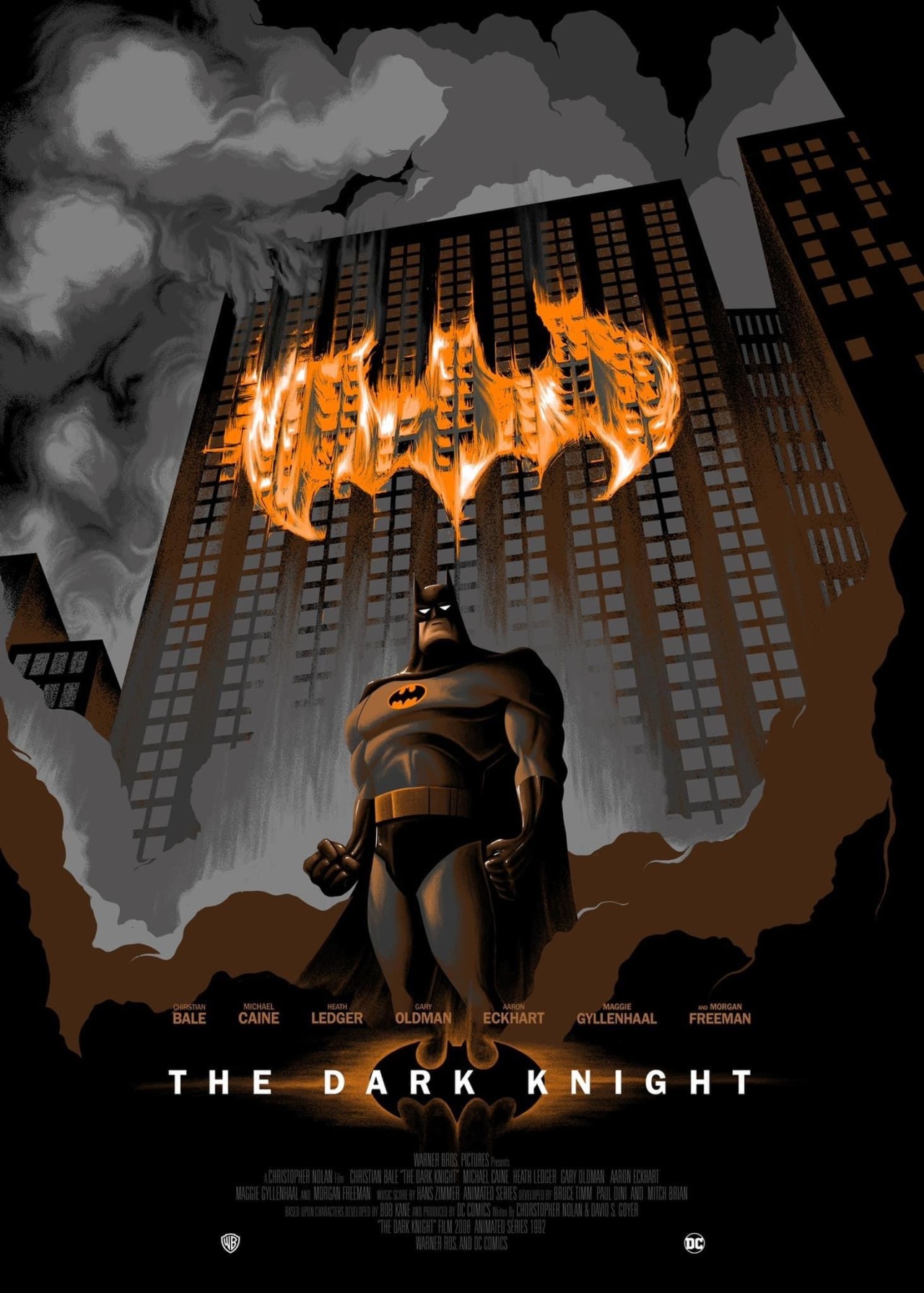
Batman movie posters by Tom Uicich
These have been out for a while, but I just came across these wonderful Batman movie poster retakes by artist Tom Uicich. Tom redid the Batman Begins and The Dark Knight posters in the Batman Animated Series style.

Saturday, September 14, 2024
Terminal: John Paul Leon Batman two-part story
I stopped collecting monthly comics some years ago but I still keep up with the "big two" publishers via Marvel Unlimited and DC Universe Infinite Ultra. On the latter, I've been on a Batman kick lately. I came across this little gem from 2014: Detective Comics 35-36, a two part story by Benjamin Percy and John Paul Leon called Terminal.

The cover is unusual. Usually, editors prefer the hero to be prominent on the cover. Here, Batman is in the background, although the vanishing point draws you to his image. The story concept is somewhat reminiscent of the Fox TV series Fringe. In the 2008 pilot episode of Fringe, a plane mysterious lands at Boston airport: all the passengers are dead, due to a biological agent released. The plane landed on autopilot (which doesn't seem right). In Percy's story, all passengers are dead, but it is due to a virus that ages them super fast over a 24 hour period. However, the plane does NOT land on autopilot...

...it actually crashes into the airplane terminal, which John Paul Leon illustrates in terrific detail. I think this makes the story both more exciting and believable at the same time. I can't help but think of Tom King's 2016 Batman #1 rebirth/relaunch, where he had Batman get on top of a jumbo jet and try to divert it from crashing into Gotham City. Here, there's nothing Batman can do to avoid the disaster. His role is to play Detective, which matches the name of the comic.

How does Batman get involved with all of this? The story starts off establishing a mood right away, where Bruce Wayne is being driven to the airport by Alfred. Alfred wants Bruce to take a vacation. But Bruce will not be getting a trip to paradise.

Bruce, a billionaire, naturally has his own luxury private jet. While he's waiting inside, drinking tea and reading the paper, Alfred tells him they can't take off because of the emergency. I love this page, the way it is illustrated and the relationship between Bruce and Alfred. There is some Mazzucchelli influence here. (Bruce/Batman needs Alfred in his life; DC made a huge mistake getting rid of him.) Note the headline on the newspaper, that's not a throwaway gag.

Batman is the first one into the crashed airplane, naturally, investigating the crime scene before the airport police get in. The head of the airport cops is stunned to see what's inside, and to learn from Batman, that the airport must be sealed immediately - no one should come in or leave. The decaying virus is spreading and both Batman and the police chief are infected. They've only got 24 hours or less to live.

The terrorist who released this virus on the plane is revealed as an eco-terrorist, Mangus Magnuson, who wants the United States to withdraw from the Middle East, in return for the antidote. And what's remarkable is that this story is concluded in the next issue: something we don't see much anymore, a two part story. Usually the editors want to drag stuff out for six issues to put into a collection. Perhaps it was conceived as a fill in to give the regular artist a break.
It's not a perfect story. As I mentioned, the plane with the people dead seems way too similar to the Fringe pilot. The antidote is eventually discovered - but after Batman and the police chief have aged up. So the antidote not only cures the virus but reverses the aging process? Isolate the latter please and mass market it, no one needs to be old anymore.
But I do like this moody, suspenseful type of Batman story where he's working in darkness and using his detective skills to solve a problem. I probably wouldn't like it if John Paul Leon hadn't done such a good job of illustrating it. We lost him in 2021, way too soon.
Monday, August 12, 2024
Marvel Comics advertisement for retailers in 1973
This 1973 Marvel advertisement was designed to appeal to retailers across the country. Not the direct market - that did not exist yet. This was for newsstands, grocery stores, drug stores or convenience stores such as 7-Eleven or Quik Mart. Marvel Comics at that time sold for twenty cents per comic. The retailer would make 6 cents profit per comic. So, if they managed to sell 100 comics, the retailer would make $6 of profit? Doesn't seem worth it, even with all prices being lower back then. I love the box on the side showing the titles of the Marvel black and white magazines.

Tuesday, July 30, 2024
Star Wars try-out strips by Al Williamson from 1977
Star Wars became a big hit in 1977, both as a film and a Marvel comic book series. Star Wars also had a daily newspaper strip that ran from 1979 to 1984. When the feature first debuted, the artist was Russ Manning, known for Magnus, Robot Fighter, Tarzan, and other Gold Key comics. Al Williamson, who I think most people would say is one of the best Star Wars artists, took over the strip from 1981 to 1984 - and also did Marvel's Empire Strikes Back adaptation.


Monday, July 22, 2024
Peanuts and Lil Abner / Al Capp
From Lil Abner comic strip by Al Capp, in October 1968: three Sunday strips taking on Charles Schulz and Peanuts. In an early 1980 issue of the Comics Journal, there was "Al Capp: The Last Interview" by Rick Marschall - actually conducted in October 1977. Capp: "Peanuts is a great strip, but no one has ever said, publicly, that they don't like Peanuts." Later: "In America, you must like Peanuts, even if you really don't."
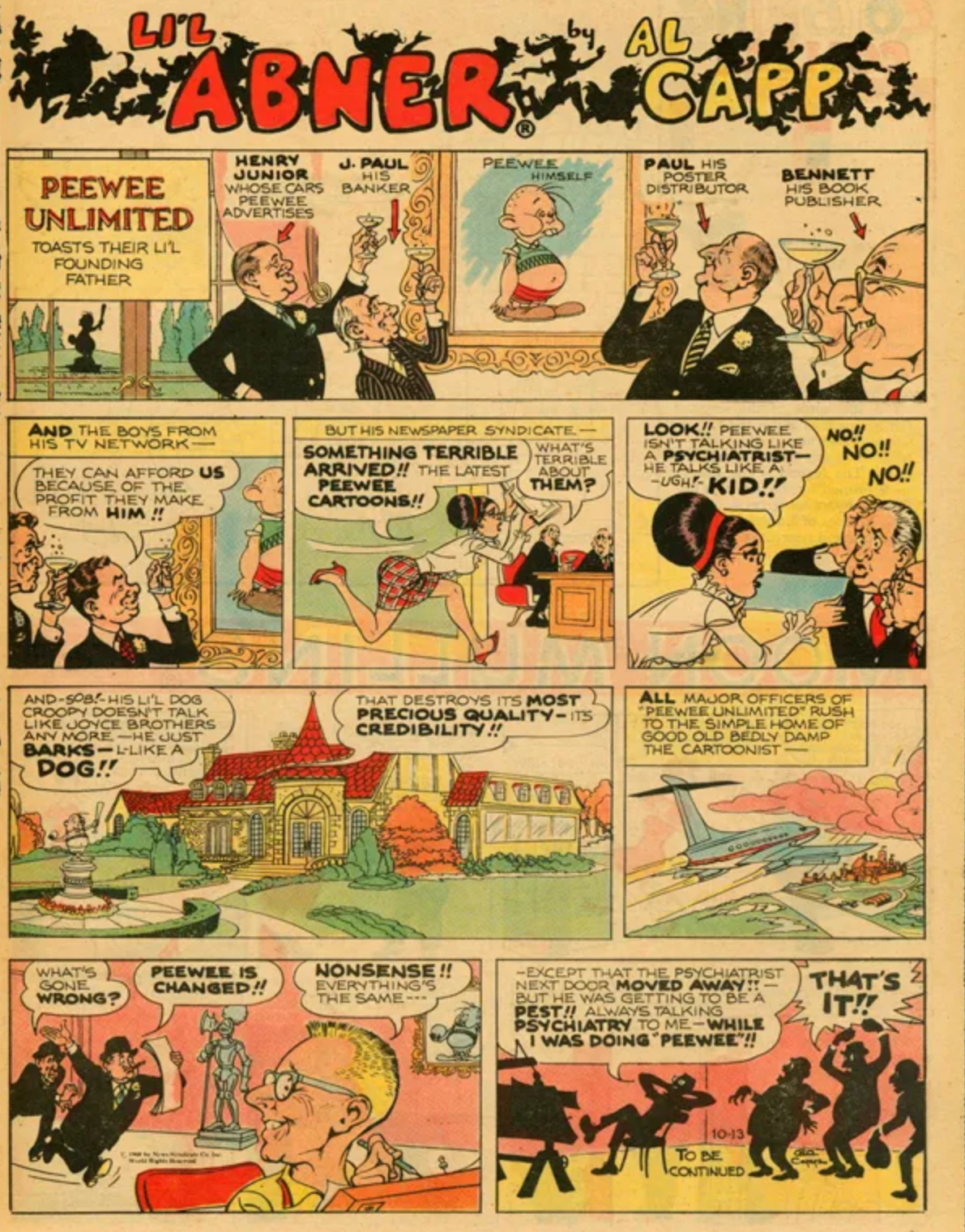


On Dan Brady's blog, you can read a Los Angeles Times article where they asked Charles Schulz his opinion about the parody. He didn't think it was very funny.
I think this parody's good in a Wally Wood kind of way! Although I really do love Peanuts more than ever.
Sunday, July 21, 2024
The Joker by Brian Bolland from 1988
This is an illustration by Brian Bolland from 1988 for USA Magazine. This would have been the same year that The Killing Joke was published.

Thanks to Colin Smith for sharing this image!
Saturday, July 13, 2024

Monday, July 8, 2024
Alice & Jack: Pointless and Stupid

Alice & Jack was a highly promoted series on PBS Masterpiece earlier this year. Six episodes, I recorded all the episodes and finally watched them months later. I was fascinated by the first episode; some reviews have said this show was a waste of time - I thought they must be wrong. By the time I finished the series, those reviews turned out to be correct. I have a feeling this show was pitched as "Normal People for Adults" but it has none of the nuance, nor any sensuality.
Alice and Jack meet on a Tinder-like date (in 2007, before it existed) and have a one night tryst. I can see why Alice likes Jack (Domhnall Gleeson) but I can't figure out why he's so crazy about her. Alice is rude and abrupt, though she softens up later on. There's a trauma from her childhood, touched upon briefly in one episode, to explain her behavior, but it all seems shallow. Everything seems like a plot device rather than an exploration of character. Andrea Riseborough portrays Alice as best she can, eyes welling up with tears at any given moment. At one point they haven't seen each other for two years, then Alice sends Jack an invitation to her wedding. Jack is pissed - but TWO YEARS have passed - Jack has a PhD and is a scientist, why wouldn't he assume she's moved on? Why didn't Jack move on? It's ridiculous. Whenever one of them appears to be in a good relationship with someone else, they come back together and it blows up everything. Again, it's unexplained, there's hardly any sex involved (not looking for graphic sexual content, but often people lose their heads over someone they are highly attracted to), and Jack does one dumb thing after another.
Years and years pass, Jack is still single - a highly educated and successful person with no problems other than he thinks of Alice too much. He starts off dates by telling women he's hung up on Alice. Then towards the end, when Alice has stage 4 cancer, Jack has an aortic aneurysm - the doctor explains that he could die of an aortic dissection unless he reduces his stress level. I could predict that he would die very close to Alice's death - and that's what happened. It's supposed to be poetic but I see the writer's plot machinations and it just seems stupid.
The other problem is this show is two episodes too long. The fifth episode is mostly about the two of them wandering around London discussing their history. The sixth episode has Alice pass away early, with flashbacks to scenes we've already watched in the previous five episodes, just padding it out to meet the running time. I don't know why I stuck with it other than I like Domhnall Gleeson, but he was wasted here.
Friday, July 5, 2024
New X-Men by Grant Morrison: Doom Patrol, redux?

I've been on a mutant nostalgia trip lately, fueled by the X-Men 97 animated show that debuted this year. That show rocked; it picked some great stuff from the comics, put their own spin on them, and made a terrific show. The soap opera elements also worked, with a romantic triangle between Magneto, Gambit and Rogue. I've found the Krakoa era comics to have peaks and valleys - it started off well enough but seemed to get bogged down. Watching X-Men 97 was like a visit to an earlier time. So I decided to re-read Grant Morrison's 2001 New X-Men run, which inspired the sequence in X-Men 97 where the nation of Genosha was attacked.

I found the entire New X-Men run to be hit or miss. When Morrison's stories are illustrated by his frequent collaborator, Frank Quitely, the combination of the two is really spectacular. The first three issues are a massive change from the status quo of the X-Men for the previous decade. The X-Men are taken out of their Jim Lee era costumes and placed into leather uniforms designed by Quitely, which both new and old, as the X motif across the chest is styled after the X-Men's 1960s uniforms. The attack on Genosha (which is not really depicted in the detail it was on the animated episode) reduces the mutant population to 200 or so mutants. Morrison felt there were too many mutants in the Marvel Universe and wanted to bring it back to that 1960s era when they were truly a minority. Magneto is dead, seemingly.

Emma Frost joins the team, becoming yet another villain turned hero and joining the ranks of Rogue, Quicksilver and the Scarlet Witch. Her arrival threatens the sanctity of the Scott Summers / Jean Grey marriage, with a flirtation that continues throughout the run.
Morrison and Quitely create a new super-villain, Cassandra Nova, who is later revealed to be the twin sister of Professor X. Cassandra will be appearing in the Deadpool vs Wolverine movie.

There are clever new little inventions, like the faculty conferences held in mind-space, linked up by the telepaths on the team. They can be dispersed across the world and still have a meeting. Even with a meeting, Quitely can illustrate this with skill, showing the body language and attitude of each character.

Quitely is so good it is hard to read the issues without his work. And that happens very quickly, as he is not a very fast artist. Igor Kordey subs in for Quitely on a number of issues in the first couple of years and to my taste, it's horrible. My understanding is that because of deadline pressures, Kordey drew these issues quickly, and that his European artwork is much better. Ethan Van Sciver, Chris Bachalo and Phil Jiminez also drew a number of issues and their work is much better, but nothing like Quitely.

Not all of Morrison's inventions work for me. Fantomex, a character inspired by the Italian thief Diabolik, left me cold. I didn't think he was cool and I kind of dreaded seeing him pop up in any story. Making him part of the Weapon X program and doling out hints to Wolverine about his origin - whatever.

One of the things I liked about this run was Morrrison creating new mutants that really seemed weird. This is a repetition of what Morrison did in Doom Patrol at DC Comics. Xorn, when he initially appeared, was a character I loved. A mutant with a tiny star in his head (how that works, don't ask me), he can produce gravitational affects and also seems to be good at healing people. An innocent from living in a prison for quite a while, he had no idea how to deal with everyday people. There's one issue with Xorn, drawn by John Paul Leon, where he wants to save any mutant he can from persecution. Later on, it's revealed that there is NO XORN - that was actually Magneto under the mask, fooling and working alongside the X-Men for the entire time! This was a surprise when I read this stuff 20 plus years ago, but now, it makes no sense whatsoever. I almost think that Morrison created Xorn as a new character and then decided half way through to make him Magneto. It is a repeat of the plot that Morrison used in Doom Patrol, where towards the end, it is revealed that The Chief is a villain behind the tragedies that happened to the DP team members. When Magneto returns, he's more evil than ever, murdering people left and right, far away from the character today who is more of a hero. It is such a terrible plot device that Marvel retconned it - Xorn was someone who believed himself to be Magneto. Again, it makes no sense, but if it undoes Morrison's mistake, I can live with it.

I think there are three high points for the entire Morrison New X-Men run. The first one being the initial three issue arc that introduces the new status quo. The second one is a single issue, New X-Men 121, where Jean Grey and Emma Frost take a psychic journey into Professor Xavier's mind, which was hacked by Cassandra Nova. (This later inspired an issue of Giant Size X-Men by Jonathan Hickman and Russell Dauterman.) The third one is "Riot at Xavier's" where the adversary for the team is the students at the school. Quentin Quagmire brings a skinpunk attitude against the pacifistic teachings of Xavier. Some of the kids are taking a drug called Kick which amps up their mutant abilities temporarily. Xavier badly ignores this threat until a full blown riot erupts - precisely on the Open House day when normal people and press are invited onto the campus.

Was this the origin of the "Magneto Was Right" slogan and t-shirt? Perhaps so. Quentin Quagmire is really a cool character that has stuck around.

One problem with trying to read X-Men is with so many series throughout the years, it is hard to read something in sequence that explains what happened. Quentin apparently dies at the end of Riot. He gets resurrected later, dies again, and lives again. I am trying to follow the trail of continuity but it is difficult. There could be an "All the Marvels" book just on the X-Men alone. Quentin will be in the new July 2024 X-Men team, where Cyclops tells him, "Please Quentin, you've died more times than any other mutant. You should be used to this."

The Stepford Cuckoos were a delightful addition, a set of telepaths at the Xavier school. Five of them who are linked together, their numbers get cut down by two. Morrison's sense of humor throughout this series is pretty good, although at times there are so many humorous moments that it almost feels like a parody comic.

Riot at Xavier ends with a subplot that everyone wanted to see move along - Scott's infatuation with Emma. Which isn't entirely physical - Scott has been traumatized after being possessed (before New X-Men) and seems to be more repressed than ever around Jean. Emma comes on to Scott in the most seductive way possible, by donning a Dark Phoenix costume.

When Jean Grey discovers all of this is going on, the result is explosive, in a trashy, soap opera way. The equivalent of Krystle vs Alexis on Dynasty - an outdated reference to a nighttime show from the 1980s. But it does lead the way to a new status quo after Morrison leaves: for Scott and Emma to really be a couple in love. I've no idea when they fall out of love - Scott is now exclusive to Jean again in 2024 post Krakoa.
The last two arcs of Morrison's run seem tame compared to what has come before. The arc where Xorn is revealed to Magneto, who terrorizes New York and starts to organize human executions. Jean becomes a full Phoenix again, dies again, while Wolverine kills Magneto. It has none of the wonderment or charm of the high points that I mentioned. The "coda" arc, four issues illustrated by Marc Silvestri, which look gorgeous, is a future history where mutants have taken over the world, opposed by Wolverine, Cassandra Nova, and others. The Beast is a villain - ironic, considering Beast was a villain in the Krakoa era as well. It's okay but the main point seems to be for a revived Phoenix to give Scott a blessing to turn to Emma for comfort and in doing so, stay with the X-Men - undoing the horrible future that is to come.
What could be done with the X-Men after Grant Morrison leaves? They made an uneven run but it was revolutionary. Fortunately, Marvel honcho Joe Quesada, on the day he learned of Morrison's departure, ran into an obscure TV hack who might be able to follow up: Joss Whedon.
Monday, June 17, 2024
Belgium's Comic Strip Trail
Last week, I returned from a vacation in Amsterdam and Belgium. When I visited Brussels, one of the top things on my list was to find as many murals on the Comic Strip Trail that I could. I actually did not realize before this trip, that many European comics that I have seen were actually created by Belgian creators. I knew of Tintin and XII, but didn't know the creators were from this country. I am still reading more and expanding my horizons here.

The mural I most wanted to find was Tintin and this was actually the easiest! First, we visited the infamous Manneken Pis statue in the historical area. Just up the street from that, in the direction of La Grand Place, there is a comic book store, "Moule a Gaufres". I could have bought so much here, but with limited suitcase space, I settled for a Tintin mug. I was fascinated by the quality of all the comic albums (graphic novels), literally hundreds of them and most looked appealing. Emerging from the store, I turned around and saw...the Tintin mural (above)! It was very cool.

Actually, the first mural I saw was not Tintin but Olivier Rameau, a short distance before I got to the Manneken Pis statue.

A short walk away from La Grand Place, near the Central Station, there is a tunnel, where the ceiling is covered in an enormous mural of The Smurfs. I had no idea the Smurfs were created in Belgium! This one photo does not do this justice. It is large and contains many easter eggs related to Brussels.
I think I found these three, then I did not find any others the rest of the day, which spent being mesmerized by La Grand Place and the historical center.

I went back on my last day and figured out a route to find the other murals near the historical center. It was pouring rain on this day; luckily, I had an umbrella. I really wanted to find the one for XIII, which was near a cafe. Mostly the character resonated with me from the PS2 video game, but I started reading his adventures on this trip. It's a cool spy comic with some elements in common with the Bourne Identity.

The other one I had hoped to find was Young Albert. I have not read this strip but I love how the trams and trolleys operate in both Belgium and Amsterdam. It gives me a quaint European feeling that no American city does. There is a volume of this on Kindle Unlimited, so I will give that a read.
Here are some other photos I took...


It was all I could do to see these murals on my last day. We were worn out by the end of our two week trip. At least I had seen a majority of the murals in the historical center, although I missed a big one: Thorgal! You really have to plan out where you are walking in order to see these things. I had marked the Thorgal location on a map but I took a wrong turn and by the time I realized it, I was too far north and too exhausted to go back for it. I love barbarians but I don't have their stamina! However I did download a collection of Thorgal comics and will be reading those soon.
There are many more murals outside of La Grand Place - this site has a complete list of them. For example, in the Sainte-Catherine area, there is a Corto Maltese mural - I wish I had seen that. Hmmm...Hugo Pratt was not a Belgian, right, he was from Italy? Perhaps not all the murals feature characters by Belgian creators.
Walking around and ogling these photos, I felt kind of strange - I was apparently the only one on the street truly excited about seeing them. Everyone else was more interested in the pissing statue or eating a waffle.

I also ran across an advertisement for a Blacksad escape game!
Dylan Dog meets John Constantine
I read the Batman / Dylan Dog limited series, three issues, all available now on the subscription service, DC Universe Infinite Ultra or whatever it is called. I've never read any Dylan Dog material before, I thought this was very good, apparently written and drawn by creators in Europe. Dylan's assistant Groucho (who resembles Groucho Marx) cracked me up - would this be possible with any modern celebrity?

The second issue of this team-up is the best, because it really doesn't involve Batman very much. The story is about Dylan Dog, who needs to take a trip to Hell to see if a serial killer named Killex is still there - or has his soul been called back to Earth? To accomplish this, Dylan Dog, who is in London, looks up John Constantine, Hellblazer. Constantine takes Dylan to Hell - but this version of Hell looks like the modern Piccadilly Circus!

This leads Constantine to reminisce about what this location was back in the good old days - the 1980s. I visited here around 1978 and remember it pretty much the way Constantine does. People were sitting around that fountain, eating fish and chips or smoking a cigarette. It was very busy but not overcrowded. When I re-visited this area in 2015, I was astonished at how commercialized the area was and people were swarming the streets. I imagine people have the same feelings about Times Square in NYC.

Constantine continues his take down on modern life, music and social media on the next page. Everybody has their own personal version of Hell - for Constantine, this is it, modern-technological Piccadilly Circus. Dylan rebuts this take-down on the next page, by calling Constantine a "boomer". Later in the story, they are aided by another supernatural DC character, The Demon.
All in all, this was a fun series and it was good to learn about Dylan Dog. Hardly any of his adventures seem to be translated to English. John Constantine was very entertaining in this second issue and is prompting me to re-read some of the other Vertigo stories.
Monday, March 6, 2023
It’s Superman by Tom De Haven
I never thought I would rate a licensed Superman novel as high as this one, it’s right up there with Kavalier & Clay for me. It’s Superman by Tom De Haven was published in 2006 and it never registered on my radar until a few years ago, when Howard Chaykin (on his Facebook) recommended this - more than once!
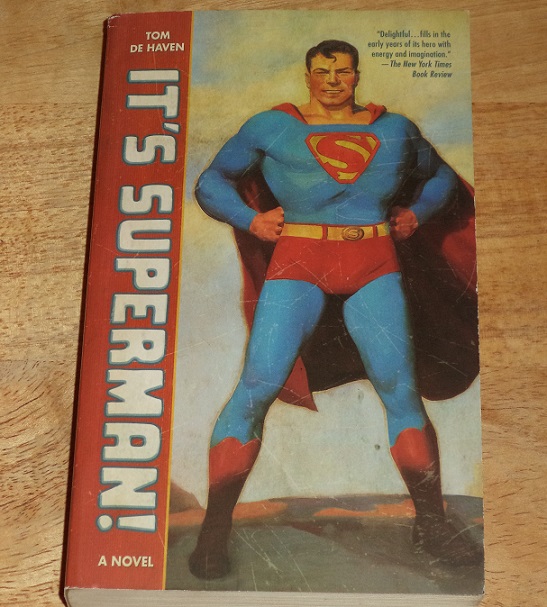
If you’re a Superman fan and are okay with a revisionist take, this novel is for you. We’ve seen Superman as a young man in the Smallville TV show as well as in DC’s Superboy comics, where he was a teenager in the 1940s or 1950s. This novel places his teenage/early adulthood years in the late 1920s / 1930s, which lines up perfectly with the debut of Action Comics 1 in 1938. This is quite a mature and well researched novel; the author knows a tremendous amount of that era, from how people went to the movies on Saturdays to what they listened to on the radio. (I didn’t know, for example, that Les Paul sang under the name Rhubarb Red.) I laughed during one chapter where an inept kidnapper is frustrated finding a phone booth that works in these small towns. Clark Kent is the protagonist, a loving son and wannabe reporter, a country bumpkin once he leaves Smallville. During Clark’s early years we see Lex Luthor & Lois Lane, in New York City, where they bump into famous historical figures such as Mayor La Guardia. Lex has his own story arc, from small time criminal to becoming an NYC Alderman and an even bigger criminal mastermind. Willi Berg, a photographer who gets himself into more trouble than he can handle, is the first of Lois Lane’s boyfriends that we meet; if you’re into a saintly version of Lois, this will probably offend you, but it is a portrait of a very determined reporter. The Depression is plainly evident after Clark leaves Smallville and travels to other states, including Texas & California. There’s a slow burn before Clark flies or puts on a costume; the story is more about the Odyssey he goes on, but it still forges the same New Deal American hero that Siegel and Shuster created.
Scott Brick does a superb job on the audiobook, telling this story with different accents. I thought this is one of the very best novels I’ve listened to.
Sunday, May 29, 2022
Nine Great Comic Book Artists from Silver/Bronze Age eras
I saw this on Facebook and had to save it for posterity...

These are the artists of my formative years as a comic book fan, from 1969 to 1979. I shared this in the Jim Aparo Facebook group and people really went crazy for it. I am not sure who did the portraits, was it Alex Ross? I was very happy indeed to see Jim Aparo on this list, I loved his Batman in Brave and the Bold, and also his depictions of the Spectre and the Phantom Stranger.
Each of these creators are depicted with their most famous creations. Curt Swan may have drawn the first comic I had ever read - I was crazy about Superman as a kid and picked up Action Comics after seeing the Superman cartoon show. Neal Adams was not only famous for Batman but he was drawing tons of DC Comics covers, especially on Superman/Action Comics. Gil Kane was drawing Green Lantern for years, but I especially remembered seeing his covers on it when Donovan's Sunshine Superman was playing on the radio. And of course, I knew Jack Kirby and Steve Ditko from Marvel Comics, more so from the reprint comics that had early Fantastic Four and Spider-Man tales. John Buscema I knew from the FF and Conan. Joe Kubert was more of an acquired tasted as a young kid, but I got into him when DC took over the Tarzan license.
Sunday, April 24, 2022
The Batman - Adam West vs Robert Pattinson
I watched The Batman on HBO Max. I enjoyed it. The cinematography was superb and I loved the Riddler taken seriously. I liked the portrayal of Catwoman. Batman has never used his detective skills better than he does here. It had some elements from Scott Snyder and Greg Capullo's Batman Year Zero and other things from The Long Halloween. Some stuff from Geoff Johns' Batman Earth One graphic novel as well.
I remember when the Christian Bale/Dark Knight Rises movie came out and Dial B for Blog photoshopped all these great posters featuring Caesar Romero as the Joker. Here's a great take on that theme, with Adam West in the new movie.
Spoilers...
Afterward I thought that Batman is not really that effective in the movie; he doesn't really trigger any meaningful change as he does in Year One, where he and Gordon partially clean up the Gotham police. What does the Batman really accomplish? The Riddler is more of a hero than Batman is, if we factor out his terrorist methodology, because he exposed the corruption and got rid of Falcone, Maroni and Colson. Batman punched a few criminals, helped Catwoman and saved people from drowning in the end. Once again, the villain is more important than Batman in this movie.
The other thing is going down the well-trod path of making his parents flawed. This also happened a few years ago in the Superman comics, where we found out Jor-El was a bit flawed.
Thomas Wayne was a billionaire, ergo, he must be slightly crooked? Thomas was a surgeon as well as a rich guy; I think when Batman started he was referred to more as a doctor with a trust fund, but the wealth grew as Batman was reinvented so many times. My first thought was, if I was Bruce Wayne - who idolized his parents and mourned them - and I just learned my father was working with gangsters, wouldn't that take away some of my motivation to be Batman?

After thinking of some of these elements that bothered me, I went and re-read Batman Year One again. What a masterpiece! Nuff Said.